Company: Spine3D
Industry: Digital Content Creation & Architectural Visualization (ArchVis)
Key Leadership: Kevin Smith, Chairman and CEO
Technology Partners: Unreal Engine, Eagle 3D Streaming
Since its founding in 2003, Spine3D has evolved from an architectural visualization firm into a premier, full-service digital content creation studio. Led by architecturally trained professionals, Spine3D specializes in crafting photorealistic renderings, cinematic animations, interactive tours, and immersive VR/AR experiences.
To overcome the traditional bottlenecks of 3D rendering and the high hardware barriers associated with delivering VR content to clients, Spine3D overhauled its workflow. By adopting Unreal Engine for real-time rendering and partnering with Eagle 3D Streaming for cloud-based pixel streaming, Spine3D successfully democratized access to high-fidelity immersive experiences, allowing users anywhere in the world to access massive 3D environments via a simple web browser.
Spine3D faced two primary challenges as the demand for high-fidelity interactive content grew:
Historically, Spine3D utilized traditional software like 3D Studio Max and V-Ray. This workflow required hours of waiting for frames to render. If a client requested a simple change—such as moving a lighting fixture or adjusting a material—the team had to endure the painstaking process of re-rendering, stalling creative iteration and delaying project timelines.
While Spine3D was creating cutting-edge VR and interactive experiences, delivering them to clients proved difficult. High-fidelity Unreal Engine environments typically require expensive, high-performance gaming PCs or dedicated VR headsets to run smoothly. For many corporate clients, stakeholders, and end-consumers, this massive hardware investment and complex setup was a dealbreaker, significantly limiting the reach of Spine3D's interactive products.
To solve these compounding issues, Spine3D implemented a two-pronged technological transformation:
Spine3D transitioned its core interactive workflows to Unreal Engine. This shift eliminated the "render and wait" approach, enabling the team to manipulate lighting, swap materials, and navigate environments in real-time. What previously took hours to render can now be achieved in minutes. This real-time capability allows Spine3D to iterate instantly and even make on-the-fly adjustments during live client presentations.
To solve the distribution challenge, Spine3D partnered with Eagle 3D Streaming to utilize Pixel Streaming technology. Instead of requiring clients to download massive files or purchase specialized hardware, the heavy lifting is handled in the cloud. Eagle 3D Streaming provides the enterprise-level delivery infrastructure, allowing Spine3D's highly detailed Unreal Engine projects to be streamed directly to any device with a reliable internet connection via a simple URL.
Spine3D’s strategic technology shifts have enabled them to deliver extraordinary value across various industries.
"Futures World": EY commissioned Spine3D to visualize the cruising industry 15 to 20 years into the future. Spine3D built an expansive, futuristic VR experience where users arrive via autonomous flying vehicles, witness 3D-printed food, and explore a fully solar-powered vessel. This environment is now used by EY to spark high-level conversations with clients about the future of technology and is being adapted with multiplayer gamification (badge collecting) for internal staff training.
The Virtual Campus: Swedish advanced door solutions company Assa Abloy needed a way to showcase products like retina and fingerprint scanners. Recognizing the client's budget limitations, Spine3D suggested building a virtual university campus rather than a full city. The project was so successful that it expanded into an entire digital ecosystem, including K-12 and healthcare facilities, allowing Assa Abloy to share marketing costs by hosting partner products in the same virtual space.
Virtual Kitchen & Bath Showroom: Originally requesting a simple 2D photo-swapping configurator for countertops and cabinets, LX Hausys was guided by Spine3D to build a fully 3D virtual showroom. This ensured highly accurate reflections and lighting. Users can now walk through multiple layouts, customize materials in real-time, view full-scale material slabs, and print out specs and pricing.
By combining Spine3D's world-class content creation with Eagle 3D's web hosting and pixel streaming technology, the partnership has yielded profound results for their clients:
Democratized Access: End-users can explore massive, photorealistic 3D worlds from standard web browsers without needing to download software, install plugins, or purchase high-end gaming hardware.
Increased Conversion & Trust: High-fidelity, physically accurate visualizations eliminate guesswork. Stakeholders can clearly understand a project before "a shovel goes into the ground," significantly boosting pre-sales and marketing efforts.
Cost-Effective Scalability: Clients pay manageable monthly fees for concurrent streaming access rather than massive upfront hardware costs, allowing them to share immersive experiences with a global audience effortlessly.
The synergy between Spine3D and Eagle 3D Streaming represents the future of digital visualization. As Kevin Smith notes, "Spine produces high-fidelity digital content... but Eagle 3D provides the platform to deliver those experiences seamlessly." Together, they have successfully removed the friction from high-end 3D content, proving that the future of immersive marketing and design is not just photorealistic, but instantly accessible to anyone, anywhere.
If you are looking to leverage immersive technology for your business, here are three ways to move forward with Eagle 3D Streaming:
Share the post
Blogs


The Ultimate Bridge: Why UE Devs and Visualization Agencies Need the Eagle 3D Features Plugin
Unlock the full potential of Unreal Engine Pixel Streaming with the Eagle 3D Features Plugin. Simplify browser-to-engine communication with ready-to-use Blueprint nodes f...
A Better Way to Access Unreal Editor Remotely: Ending the Pixel Streaming Complexity
Discover how the E3DS Remote Control Plugin simplifies remote Unreal Editor access for debugging, training, and team collaboration without complex setup....

Case Study: Bridging Real-World Design and Real-Time 3D With R3PLICA
Discover how R3PLICA uses Unreal Engine and Eagle 3D Streaming to deliver real-time 3D experiences and manufacturer-accurate design assets to creators worldwide....
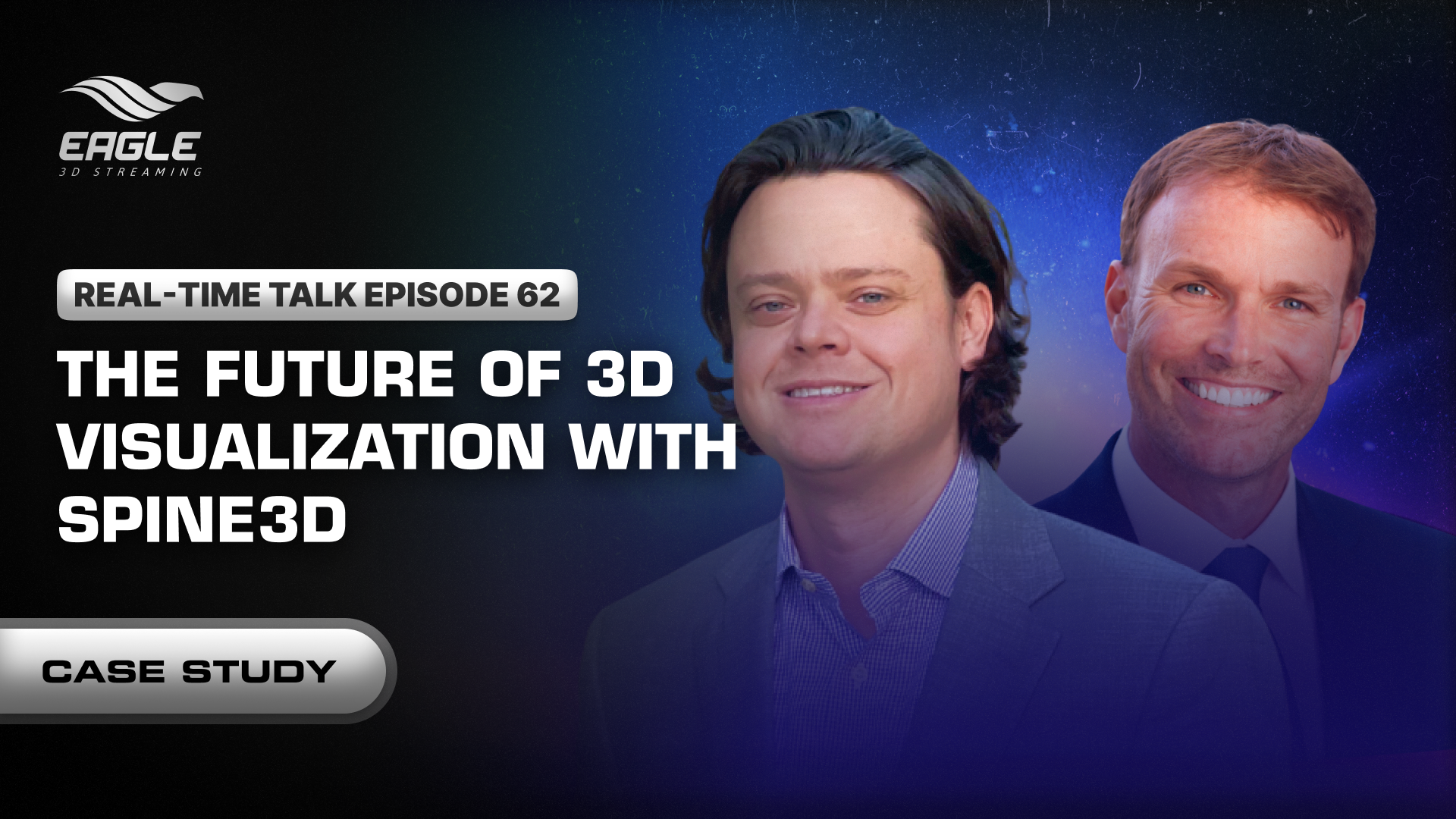
Case Study: Democratizing High-Fidelity 3D Visualization With Spine3D
Discover how Spine3D uses Unreal Engine and Eagle 3D Streaming to deliver high-fidelity 3D visualization and VR experiences instantly through any web browser....