How Ramboll Uses Unreal Engine and Pixel Streaming to Bring Infrastructure Projects to Life
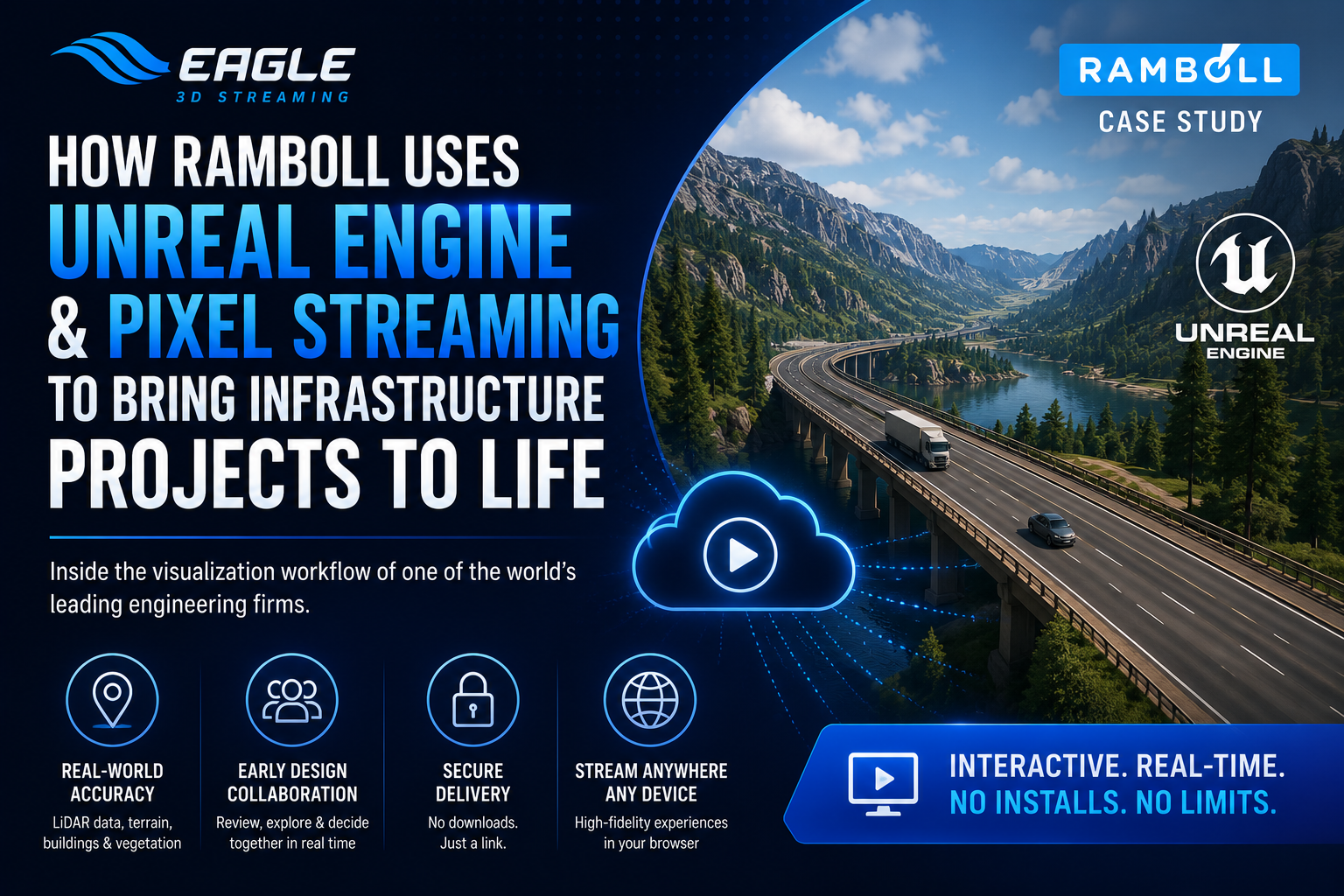
Inside the visualization workflow of one of the world's leading engineering firms — and how real-time streaming solved their biggest client delivery problem.
 MD Rafshan Tashin Eshan
July 3, 2026
7 min read
When most people think of engineering firms like Ramboll, they picture blueprints, CAD files, and static renderings. But Ramboll's in-house visualization team has spent the last several years quietly building something far more ambitious: a real-time, geographically accurate digital twin platform built entirely on Unreal Engine.
In a recent episode of Real Time Talk with Eagle 3D Streaming, Ramboll's Visualization Lead Bjornar Moland and visualization artist Eric Murbruck shared how their seven-person team turned massive infrastructure datasets — highways, terrain, vegetation, and entire cities — into interactive, explorable environments that clients can access from a browser link. Here's a breakdown of their journey, their workflow, and how pixel streaming became the missing piece of the puzzle.
From Digital Maps to Digital Twins: Ramboll's Visualization Origin Story
Ramboll's visualization department didn't start out building game-engine environments. As Bjornar explained, the department's roots trace back to digital map-making in Norway. That mapping heritage turned out to be a massive advantage: Norway has exceptionally rich, freely available LiDAR data, meaning Ramboll can pull accurate building footprints, terrain models, and even individual tree positions and heights for nearly anywhere in the country.
As Bjornar put it, "I think the main turning point was when Unreal Engine was teasing about Unreal Engine version 5." The real turning point came in 2020, when Unreal Engine began teasing Unreal Engine 5 and its Nanite technology. Ramboll had already been experimenting with Unreal Engine 4, testing whether their large-scale infrastructure models — some stretching dozens of miles — could be brought into a game engine without falling apart. The timing coincided with COVID-19 lockdowns, which gave the team space to explore the technology further while normal project work slowed down.
Why Unreal Engine Succeeded Where Traditional 3D Tools Fell Short
Ramboll's team had two decades of experience with traditional rendering tools like 3ds Max, producing high-quality still images and videos for clients. But according to Eric, the real breakthrough wasn't visual fidelity — it was real-time interactivity. As he described it, the goal became "to offer clients a real-time immersive experience for their projects."
Clients had grown used to polished renders, but those were static. The moment Ramboll could hand a client a fully explorable, high-fidelity 3D environment they could walk or fly through themselves, the reaction changed entirely. Compared to laggy, flat-shaded collaboration tools clients had used before, Unreal Engine offered something genuinely new: the ability to drive down a highway that didn't exist yet, or check how a proposed road would look next to existing vegetation and tree heights.
Inside Ramboll's Environment-Building Pipeline
One of the most striking parts of the conversation was how Ramboll's internal teams work together to produce these environments. The visualization department is split into three specialized groups:
- Geomatics — delivers the base 3D models for every project
- GIS — builds themed maps and spatial analyses using platforms like ArcGIS
- Visualization — takes that data and brings it into Unreal Engine
The pipeline works like this: LiDAR point cloud data is processed to extract individual trees, which are represented as cylinders. That data passes through FME software and is exported as a text file, which Unreal Engine then reads to populate the environment using Ramboll's own tree asset library — matched against real regional data on tree species distribution across Norway.
The scale involved is genuinely impressive. Ramboll's environment models can stretch 80 to 90 kilometers, and their largest project to date includes 1.8 million individual trees, each represented with roughly a million polygons. Bjornar summed it up simply: "It's quite fascinating how much data you can get into this platform."
Ramboll Interactive: A Custom Platform Built on Unreal Engine
Ramboll built its own internal platform, called Ramboll Interactive, on top of Unreal Engine. It includes custom UI and tools designed specifically for infrastructure and engineering review — letting project teams switch between design scenarios, toggle variations on and off, and conduct early-phase design reviews together.
As adoption grew, the visualization team found itself involved earlier and more continuously throughout each project's lifecycle, rather than just producing a rendering at the beginning or end.
Solving Real-World Delivery Problems: Why Pixel Streaming Mattered
This is where the conversation turned to one of the biggest operational headaches Ramboll faced — and how it was resolved.
In the early days, Ramboll delivered projects as standalone executable files. In practice, this created constant friction:
- 🖥️ Clients often lacked the hardware to run large environments smoothly
- 🔒 IT departments frequently blocked executable files outright, treating them as security risks
- 📦 Sharing meant large file transfers through services like WeTransfer, with no guarantee of a smooth experience on the other end
As Eric summarized it, "without it we wouldn't be able to deliver any projects." Pixel streaming solved all three problems at once. Instead of sending a file, Ramboll now sends clients a single link — optionally password-protected — that streams the full Unreal Engine experience directly to a browser. As Eric put it, this made everything "dynamic and easy to share," whether a client was opening it on a laptop or a phone. Without pixel streaming, Ramboll would have had to scale down and heavily optimize every project just to make delivery feasible — losing the scale and fidelity that made the platform valuable in the first place.
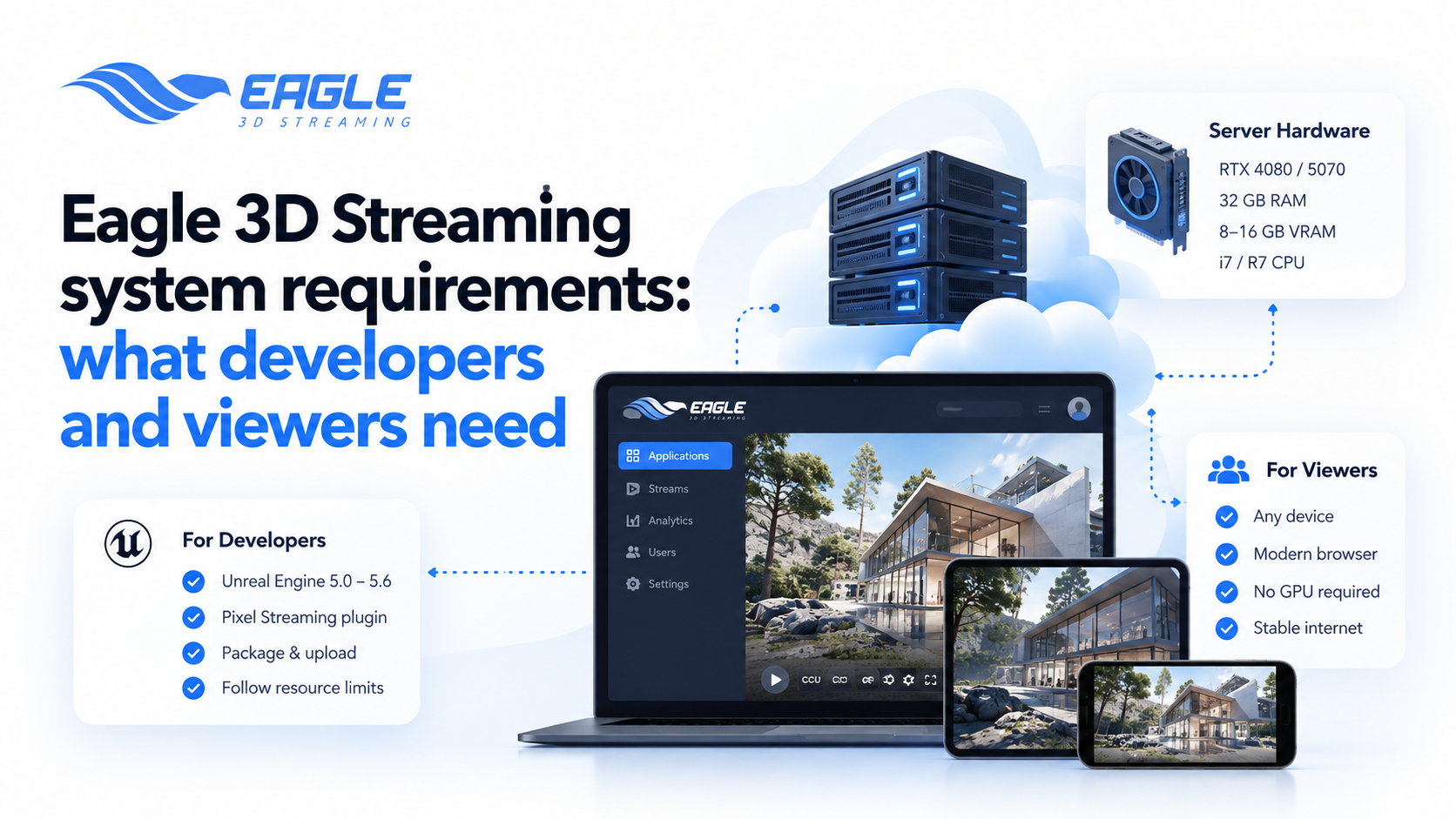
This is precisely the problem Eagle 3D Streaming's pixel streaming platform is built to solve — hosting demanding Unreal Engine applications in the cloud and streaming them to any device through a browser, with no downloads, installs, or IT approval required. Teams evaluating a similar setup can review E3DS's Getting Started guide or the System Requirements documentation to see how a project gets from a local Unreal build to a shareable streaming link.
Geographically Accurate Sun, Sky, and Lighting
Because Ramboll's roots are in mapping, accuracy is a non-negotiable part of their visualization philosophy. The team integrated the Ultra Dynamic Sky plugin and aligned it with real-world coordinates, so that sun position and shadow casting reflect actual conditions for a project's real location — down to correct night sky star positions and moon placement.
As Bjornar noted, the team wanted to be certain "the sun angle and shadow casting is an approximation of the reality." This matters more than it might seem. When Ramboll delivers a building or zoning plan visualization, the shadow patterns clients see are a genuine approximation of how the finished project will actually look and behave in daylight — not just an artistic choice made to look good in a render.
What's Next: Live Data and True Digital Twins
The team is already looking beyond static environmental accuracy toward something closer to a true digital twin. Norway's national weather APIs and historical flood data are on Ramboll's radar as potential live data sources — allowing snowfall patterns, past flooding, or live traffic conditions to actually influence the environment rather than just being modeled once and left static.
Ramboll has also experimented with material-based snow effects tied to seasonal changes, and sees UDS's volumetric snow tools as the next step toward making that more realistic.
MetaHuman Avatars for a More Human Walkthrough Experience
To make navigation more approachable, Ramboll built a custom MetaHuman avatar named Pia, complete with a Ramboll-branded hard hat and sweater — a small but effective touch that replaced the generic third-person default character the team originally used for site walkthroughs.
Key Takeaways for Engineering and AEC Teams Considering Unreal Engine
Ramboll's journey offers a useful blueprint for other engineering, architecture, and infrastructure teams considering a similar move:
- Start with your data pipeline. Ramboll's advantage came from already having a mature LiDAR-to-3D workflow before Unreal Engine entered the picture.
- Real-time interactivity beats static renders for client buy-in and early-phase design review.
- File delivery is a bigger obstacle than most teams expect — IT restrictions and hardware limitations can quietly kill adoption of otherwise great visualization work.
- Pixel streaming removes the delivery bottleneck entirely, letting teams share full-fidelity, large-scale environments through nothing more than a browser link.
Teams exploring how to bring their own Unreal Engine projects to clients without the executable-file headaches Ramboll described can explore Eagle 3D Streaming's Developer Guides or check the FAQ page for common setup questions.
Have questions about streaming your own Unreal Engine project? Reach out through the E3DS Support Portal, join the Discord community, or email support@eagle3dstreaming.com.
Share this article